
How to Make EV Ownership Easier for Apartment Residents
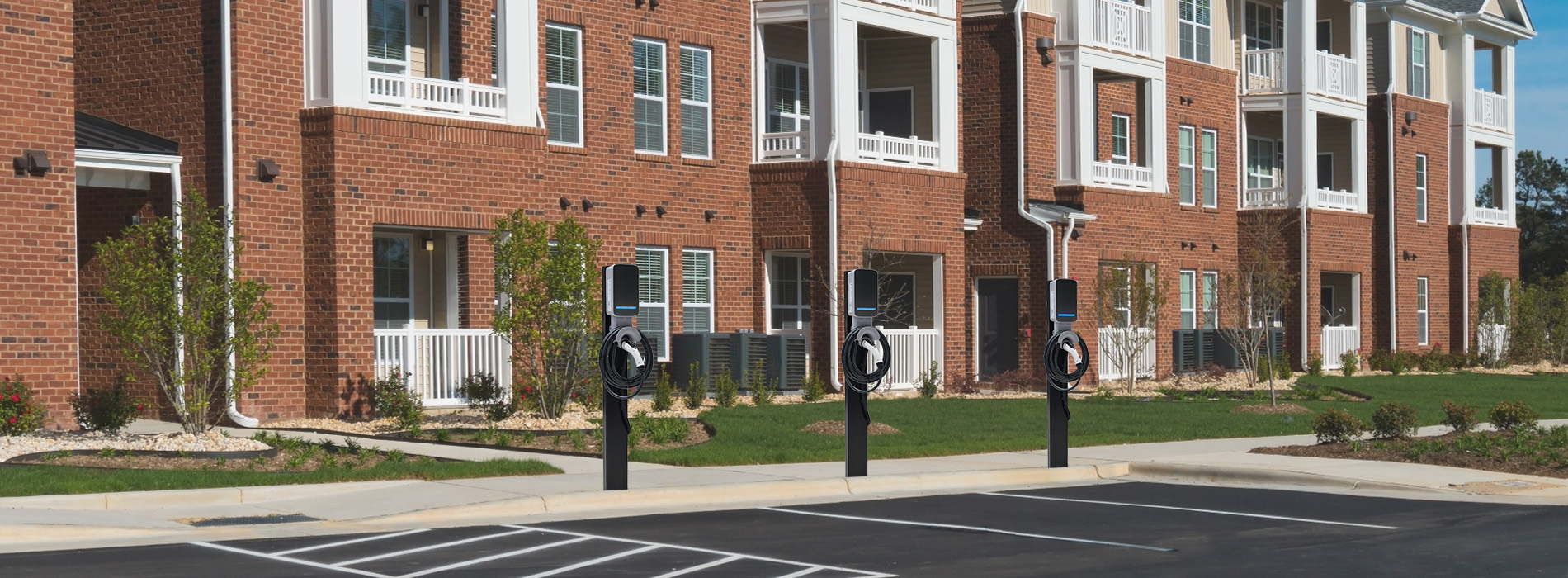
For millions of renters, especially those living in multifamily housing, electric vehicle (EV) ownership can feel out of reach because of the lack of at-home charging.
Nearly a third of U.S. households live in multifamily housing, which includes apartments, condos and other multiunit buildings. Nearly half of renter households spend more than 30% of their income on housing. With rising gasoline costs and other affordability challenges, families in multifamily housing who could benefit most from EV savings are the least likely to have access to EV charging.
Charging access is inconsistent or invisible
Nationally, one-third of EV-owning renters report having no on-site charging options.
In many buildings, the problem is not just access. It is visibility. A survey of low-income renters in California found 19% did not know whether charging was available at their residence, and 31% did not know whether there was a 240-volt outlet near their parking space.
If renters don’t see charging where they live, they assume it doesn’t exist.
Both renters and property owners face cost barriers
Without predictable, affordable charging at home, the cost advantage of EVs diminishes for renters. Public charging can cost twice as much as home charging, increasing total cost of ownership.
Property owners, meanwhile, often hesitate to install EV chargers because of perceived high upfront costs and uncertainty about how charging will be managed or billed. A property owner facing a costly panel upgrade with no clear payback will often wait. Other challenges include limited site power capacity, utility delays, and other competing demands for repairs or amenity projects.
EV adoption has been driven largely by single-family homeowners, leaving many renters behind. Closing that gap requires coordination across policymakers, utilities and property owners.
5 strategies to help expand EV access for renters
1. Incentivize multifamily charging
State and utility incentive programs can reduce upfront costs for property owners and cover make-ready electrical upgrades, Level 2 charging equipment and installation costs. Examples of programs include Charge Ahead Colorado, Charge Ready NY and Delaware’s EV Charging Equipment Rebate Program.
The most effective programs prioritize overburdened communities, include technical support, simplify application processes and fund make-ready infrastructure such as conduits, panels and wiring improvements.
2. Educate and engage tenants and property owners
While some renters say they would feel comfortable contacting property management about EV charging, most are not. Charge at Home, a partnership of organizations and government agencies that creates resources to advance multifamily housing EV charging, provides practical resources for both tenants and property owners, including:
- Survey templates to see who is considering an EV
- Installation toolkits for existing and new multifamily housing
- Case studies of successful multifamily installations.
Property owners may overestimate installation complexity and underestimate tenant demand. Technical assessments, webinars and toolkits can help clarify billing structures and demonstrate that EV charging is a valuable amenity that attracts renters.
3. Expand public and workplace charging, and explore neighborhood DC Fast charging
Public charging is not a perfect substitute for home charging but is critical to expanding access to EVs.
Public charging strategies should:
- Target neighborhoods with high renter density.
- Prioritize walkable community charging hubs.
- Ensure affordability through transparent pricing.
- Ensure chargers are visible and well-lit.
The Alameda County Incentive Project, part of the California Electric Vehicle Infrastructure Project (CALeVIP) administered by CSE, provided dedicated funding and bonus incentives for DC fast chargers in census tracts with higher renter density, in addition to supporting chargers for multifamily housing, public charging, and commercial sites. This approach of using bonus incentives and dedicated funding helped overcome site issues at multifamily housing unable to install chargers on their own.
Cities have explored innovative solutions to increase public charging. The Los Angeles Bureau of Street Lighting launched an initiative to mount EV chargers to streetlights, taking advantage of the existing circuitry. The bureau maintains a map of chargers and allows residents to request new chargers or flag broken ones.
Workplace charging is also important. If renters can reliably charge during work hours, home charging becomes less critical. Daytime workplace charging also helps with grid management by taking advantage of solar generation and reducing peak evening demand. Employers can be incentivized through tax credits, grants, utility make-ready programs and fleet electrification support.
4. Evaluate shared charging models
Not every parking space in a multifamily building needs a dedicated charger. Shared charging models allow multiple residents to use a smaller number of chargers through reservation systems, time limits or load management software.
CSE has worked with clients to develop program requirements to facilitate charger sharing between residents. In CALeVIP 1.0 projects, chargers at multifamily housing must be accessible to all residents and cannot be assigned to an individual or subset of residents (beyond those with an EV).
Workable models for multifamily properties include:
- Shared Level 2 chargers in common parking areas.
- Managed charging with access controls.
- Pay-per-use billing systems.
- Rotational scheduling for overnight charging.
The Revere apartment complex in Cambell, California partnered with EVmatch to implement a reservation system that allows drivers to identify and reserve chargers via a mobile app. The EVmatch system also allows property managers to establish charging times and set prices and idle fees. These configurations can be differentiated for residents and members of the public.
Shared charging lowers upfront costs while still providing access. Smart load management technology can allow multiple vehicles to charge without requiring major electrical service upgrades.
5. Address cost concerns clearly and directly
Many renters are interested in EVs. In the California survey, 81% of non-EV drivers said they would be comfortable driving an EV. However, the hesitation is practical and financial.
Outreach should emphasize:
- Lower fuel costs compared to gasoline.
- Reduced maintenance.
- Available rebates and point-of-sale incentives.
- Availability of nearby chargers.
For low- and moderate-income renters, focus on monthly cost comparisons, which are more immediately tangible than projected long-term gains.
States and utilities should incentivize multifamily chargers
Without multifamily charging, EV adoption will stall where growth matters most. State and utility incentives make these projects viable for more property owners. Additionally, multifamily charger programs can also provide opportunities to promote EV rebate programs and other complementary programs and assistance funded by the state agency or utility.
For advice on launching or refining an EV charging incentive program, contact consult@energycenter.org.

Devine Johnson
Director
Devine "DJ" Johnson is a recently retired naval officer with 20+ years’ experience in operations, engineering and installation management. He has led numerous strategic initiatives to enhance operational readiness for the Department of Defense. At CSE, he oversees several large-scale electric…
Read more by Devine Johnson