Unlocking the Market Opportunities of Climate Action Planning

Clean energy entrepreneurs are always looking for signals — where customers are headed, what regulators will prioritize and where capital is likely to flow. Climate action plans developed by public agencies bring those signals to the forefront.
Climate action plans, sometimes called sustainability strategies or greenhouse gas (GHG) reduction roadmaps, establish emissions-reduction goals, identify priority mitigation strategies and create market opportunities for innovative solutions. These help entrepreneurs understand where to invest in decarbonization and anticipate future market demand.
When used strategically, climate action plans can create a natural entry point for clean energy innovations and accelerate market adoption of new technologies. By understanding how to identify, influence and engage with these planning efforts, entrepreneurs can unlock new potential for their products or services.
The rise of climate action planning
Climate action planning is becoming increasingly common among organizations and municipalities.
Under the Environmental Protection Agency’s (EPA) 2023 Climate Pollution Reduction Grants (CPRG) program, 45 states, the District of Columbia, Puerto Rico, nearly 80 metropolitan areas, and more than 100 tribes received grant funding to create priority climate action plans. Grantees are required to use the funding to design plans that incorporate a variety of measures to reduce GHG emissions throughout their economies in six key sectors: electricity generation, industry, transportation, buildings, agriculture and natural working lands, and waste management. To date, some 211 priority climate action plans have been developed through this effort.
Further, according to Climate XChange’s State Climate Policy Dashboard, 23 states have climate action plans with policies enacted, meaning their decarbonization goals are supported by legislation, executive orders, rules, regulations or programs passed or established by a state governing body.
In California, nearly 73% of the population lives in a jurisdiction with a climate action plan.
The opportunities are broad
Climate action and decarbonization plans offer opportunities for entrepreneurs to address market needs in a wide range of sectors. A sample of sectors and scope of measures includes:
- Transportation
- Use low-embodied carbon materials
- Apply technologies or best practices to improve fuel efficiency
- Electricity
- Expand utility-scale renewable generation
- Deploy carbon capture and sequestration technology
- Use cleaner fuels for power generation
- Commercial and Residential Buildings
- Improve energy efficiency
- Increase deployment of distributed renewable energy
- Industry
- Improve chemical and process efficiency
- Electrify industrial processes
- Agriculture
- Reduce agricultural fuel emissions
- Adopt soil or land management practices to sequester carbon
- Waste and Materials Management
- Increase thermal biomass conversion
- Increase capture and use of gas from anaerobic digestion and landfills
- Increase recycling
Each emissions sector requires many different technologies and strategies working together to reduce greenhouse gases. That creates a wide range of opportunities for clean energy entrepreneurs.
Rather than competing for one narrow solution, innovators can develop products and services that address different pieces of the decarbonization challenge. In other words, climate action plans create openings not just for hardware companies, but also for software, financing, workforce, outreach and project delivery solutions.
Participating in climate action planning is a long-term business development strategy. The return may not be immediate, but these plans can influence future funding opportunities, procurement pathways and market demand.
Leverage climate action plans to your advantage
With climate action planning processes happening across state governments and municipal jurisdictions, how can clean energy entrepreneurs participate in and influence these efforts?
Climate action planning is an ongoing, iterative cycle of assessment, planning, implementation and measurement. The following image shows the general cycle of climate action planning, with potential entry points for entrepreneurs at each step.
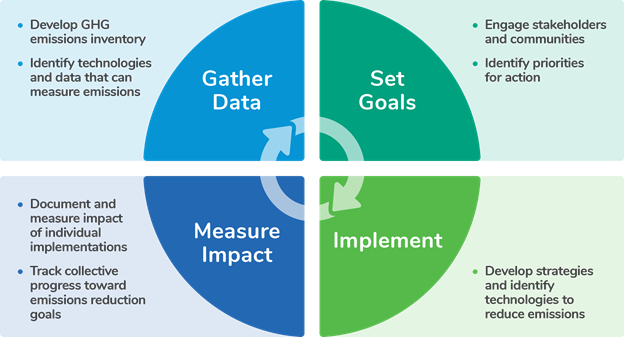
Gather Data – Offer tools to help jurisdictions measure emissions and identify priorities.
In the data gathering stage, typically where the cycle starts, the planning entity establishes an initial GHG inventory to identify the status of emissions across its jurisdiction and determine priority sectors. Accurate data and reliable tools are crucial. Clean energy innovators can support planning efforts by offering tools such as smart meters or GHG modeling platforms to help jurisdictions gain a clear picture of their GHG footprint.
Set Goals – Participate in public meetings to help shape priorities.
Once the planning entity has a sense of its GHG inventory, it must prioritize actions. This is often when agencies seek public input through workshops, advisory groups and comment periods.
For entrepreneurs, this is one of the few opportunities to speak directly with the people shaping the plan. By explaining how a technology, service or analytical tool addresses a specific emissions challenge, innovators can help planners understand where new solutions fit and what barriers they can overcome.
Participation requires time that could otherwise be spent on product development, fundraising or customer acquisition. Yet entrepreneurs who contribute to these planning processes gain valuable insight into agency priorities and position themselves for future opportunities.
Implement – Position your technology as a solution that directly supports identified climate goals.
Once goals are set, agencies begin identifying the programs, projects and investments needed to achieve them. This is a clear place for clean energy innovators to offer products and services that directly support those priorities.
Measure Impact – Provide clear performance metrics.
Data is crucial to the entire process. Clean energy technologies with strong data reporting capabilities and measurable impacts will be in the greatest demand.
Stand out as a partner in achieving climate action goals
Key actions to take now:
- Identify climate action plans shaping your target markets.
- Engage in public planning processes.
- Measure and communicate your technology’s climate impact.
Climate action plans are more than words on a page. They are practical roadmaps that signal where investment, funding and market demand are headed.
As climate action planning expands across states and communities, entrepreneurs who engage early can raise awareness of their solutions, align their offerings with agency priorities and position themselves as long-term partners in achieving decarbonization goals.
This article is part of a series written by CSE in partnership with New Energy Nexus (NEX) California as part of the CalSEED program for early-stage clean tech entrepreneurs. This series is designed to share key knowledge, actionable tools and best practices to support clean energy innovators in driving sustainable solutions forward.
 |  |
CalSEED
Administered by New Energy Nexus, CalSEED is one of several initiatives funded by the California Energy Commission EPIC program to advance energy innovation. CalSEED grants of up to $700,000 are awarded to early-stage clean energy entrepreneurs to accelerate California’s clean energy goals.
New Energy Nexus California
New Energy Nexus California supports entrepreneurs building equitable climate and clean energy solutions across the state since its founding in 2004. The team works across the full innovation journey, from early-stage funding and technical validation to market access, policy engagement, and ecosystem building. Programs include CalSEED, CalTestBed, Bay Area High Road Manufacturing Initiative (BAHRMI), and industry convenings that strengthen California’s leadership in battery innovation and domestic supply chains. Since 2016, NEX California has supported 200+ entrepreneurs and startups and deployed $58.6 million in funding, technical assistance, and ecosystem initiatives statewide.

Demetra Tzamaras
Senior Manager
Demetra (Dema) Tzamaras is a licensed civil engineer (CA C90123) with eight years of experience in consulting, project management, and clean energy program design. At CSE, Dema supports a variety of DER demonstration and evaluation projects and incentive programs. She manages a million-dollar…
Read more by Demetra Tzamaras